2021
10:50, HD, 50 fps, colour, sound
watch film here
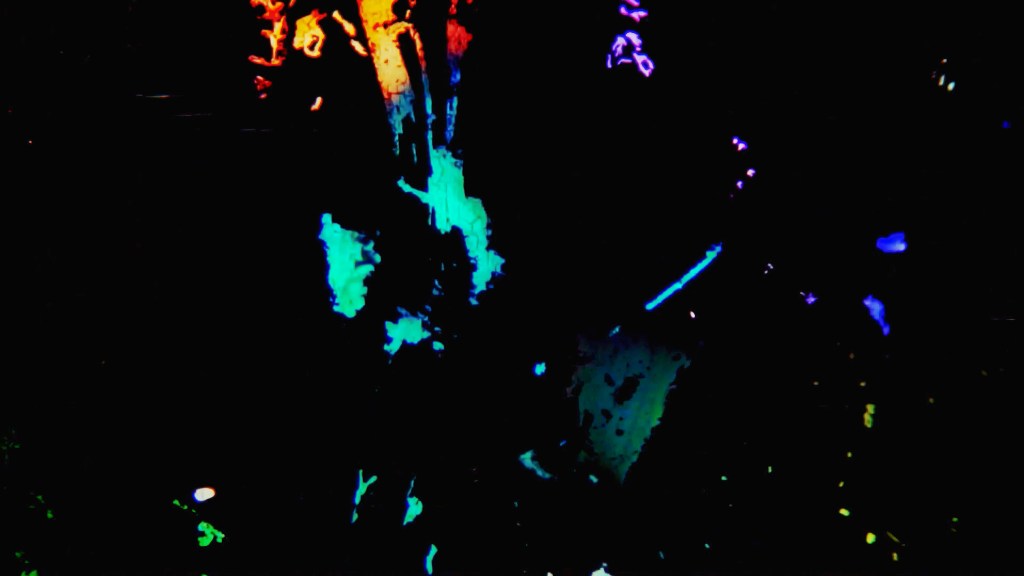
“to whom it may concern,
towards the end of 2020 an email from an unknown curator instructed me to recompose a film by Mierre Penard, a deceased obscure french artist and filmmaker who had decided to abandon society to live in the woods and follow his artistic vocation. a few weeks later the film arrived at my home, or at least what remained of it: in that wet and swollen cardboard box that was left in front of my house i found only fragments of a longer film whose delicate emulsion on the 16mm plastic strip was dissolving or flaking off. i was afraid that the work of Mierre Penard had been lost forever and that i could not recompose it. together with the cardboard box came some terrifying news: the curator had died. apparently he had written in his will to deliver all of his possessions to my address. in the cardboard box there was only film; that was everything he had. it was therefore my duty to recreate what must have been a splendid work of art. but what responsibility it was! i initially hesitated. after a careful frame by frame study of the material i realized that i was destined to fail, time and the atmospheric agents had already irremediably damaged the emulsion and my recomposition could have never been at the same level of grandiosity as the original. but i did not give up, i had to do it to make justice to Mierre Penard’s memory and finally place his work within the art canon. i grabbed my camera and started re-recording the film as it went through my 16mm projector, i had to save as much of the film as i could before it self-destroyed. as the action of rephotographing the film unfolded, a few things became clear. first, the film was a sort of language-less epic poem divided in at least thirteen sections that dealt with the death and rebirth of the human being within a post-literate society. second, the film was probably left unfinished, it did not have any opening nor closing credits, as well as the title or any of the connections between the different sections. the curator had left me with an impossible mission. i have to confess that i thought i had failed. out of the thirteen sections i managed to save only three, which, out of affection, i have named as follows: 1) dematerialization of language, 2) attack to the image and the body, 3) katabasis or descent into matter; probably they occupied respectively the placement of section 2, 7 and 13. i have decided to name the untitled language-less epic poem fragments, because any other name would have been a betrayal of the initial intentions of Mierre Penard. if at some point throughout history anybody will lend their eyes and ears to the work, i hope that they will realize that there is nothing added to fragments, i have saved as much as the material as i could and i hoped to have delivered the most neutral of the digitalizations and recompositions. on the other hand, if the hypothetical viewers don’t find any of the authentic and grandiose splendor of the original work i will take than full responsibility for my failure. yours faithfully, martin moolhuijsen PS: a few days after sending this email i received a message from Mierre Penard’s daughter telling me that her father had never actually completed the work. but the film was not meant to be left perpetually unfinished, it was since its conception destined to me. despite my recurring efforts to understand what she meant with those words, she never answered and disappeared. a few weeks later i sadly discovered that she had also died prematurely. i felt like a rat who had built the labyrinth it was trying to escape from. to this day i do not know anything else about Mierre Penard, his daughter or the meaning of (t)heirwords.”*
*martin moolhuijsen, the unpublished writings of borghesio and the difficulties of dealing with anticipatory plagiarism, (nowhere: donotpress), page unnumbered, anytime
 martin moolhuijsen